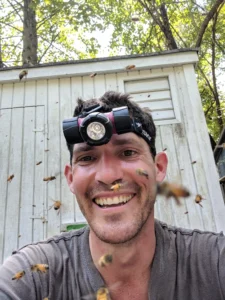
 Zac Lamas, visiting researcher at UMBC. I am broadly fascinated in how behavior drives disease transmission in social organizations. My lab focuses on how individual, minute interactions shape the disease model of honey bees. We take both an applied and basic research approach to our work. As a result we are able to uncover biological functions which drive disease transmission, and then work directly with stakeholders to improve beekeeping management. My current work is funded by Project apis M. and California State Beekeepers Association.
 Brandon Tringa, MS researcher. I am interested in how essential bee behaviors interact with abiotic variables to influence viral infections. The research possibilities in this area are seemingly endless, with a lot of practical applications for beekeepers. My current work is funded by NAPPC.
 Vrinda Thapliyal, MS researcher. I am screening compounds for their potential use as therapeutics for viral infections in honey bee queens. This is an exciting area of research. We now know queens can develop high levels of viral infection early in their life. Creating prophalactics or therapeutics is highly desired by commercial queen producers and commercial pollinators alike. I hope my work ultimately helps advance breeding programs and improve colony health. My research is funded by the California State Beekeepers Association.

Grace Wagner, undergraduate researcher. I am studying sensitivity of worker bees to different stressors after they develop viral infections. This is exciting as I will develop skills in both toxicology and virology. My basic research will uncover how interactions between stressors complicate our understanding of bee health. My work is funded by Project apis M.
 Thomas Bower, undergraduate research. I study social immunity in honey bees. Honey bees have innate immune pathways which activate genes in response to infections. Bees also have behaviors which they engage in to mitigate the impacts of pathogens. I study those behaviors, and which ones are actually reducing infections. Queen breeders will use my findings to improve queen health. My work is currently supported by the Lamas lab.

Harrison Roth, undergraduate researcher. I work with queen breeders to reduce viral infections in the queens they produce. My work allows me to visit and sample with numerous beekeepers. Ultimately, my work will create low cost assays to help beekeepers while improving queen health. My work is currently supported by the Lamas lab.
Riley Gonzalez, undergraduate researcher. I recently joined the Lamas lab, and am studying how abiotic exposures impact  bees. I am interested in using the bee as a model for human health.